Marginalia on chapter I
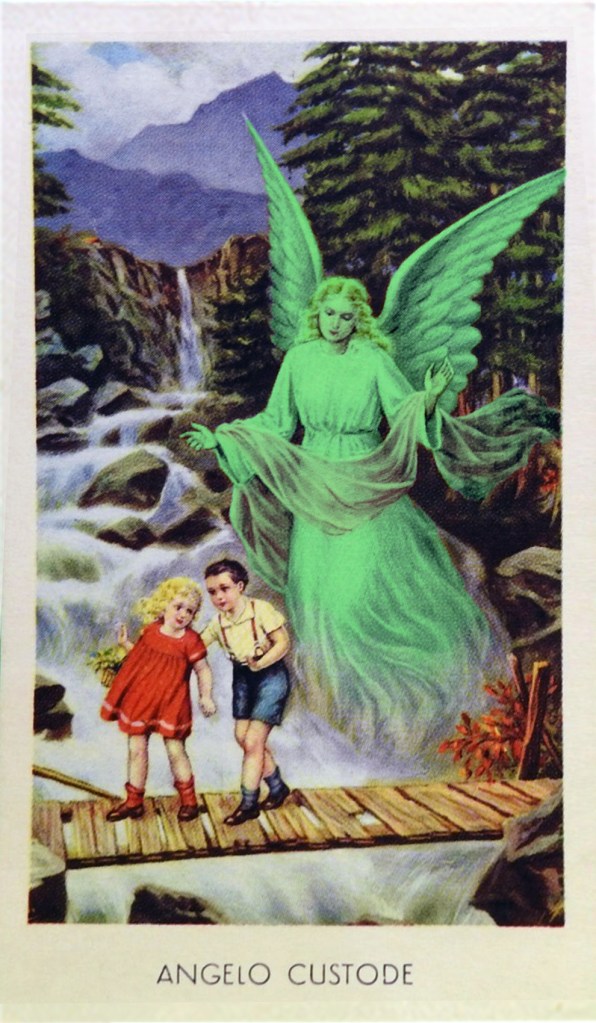
Why green?
“And I thought that perhaps, if I spoke good words and did good deeds, my voice would become pure. But I was ugly. I desired all these things yet believed I could do nothing unless everything else was also beautiful and pure. Nor did I wish to become a mere arrangement of scents and colors, though I longed to save everyone from decay and death, even while I myself was neither pure enough nor wise enough. Dear angels, what was I to do? Was I to chase people through the streets like some holy fool, crying out that the end was near?
Now the voice of the Green Angel comes back to me. It says: ‘Peace be with you; do not be afraid. Let me speak, my friend…’”
In the book, I showed, up to a certain point, a kind of abstract mind-portrait of my “personal angel,” or “guardian angel”: it is the body, or the face, of that voice that answers you when you want to talk with God in your head because you are lonely, and tells you, “Don’t go there,” “Go that way,” “Do it like this, not like that,” or even just, “Hush.” So he is God’s messenger and one’s personal friend; he walks with you and sometimes makes you smile with his oddities, or even makes you laugh when you are down.
It is said that angels were not always portrayed with wings; only the archangels and those above them, the cherubim with four faces (eagle, bull, lion, and human) and four pairs of wings; and higher still, the seraphim, with only a human face—or perhaps several eyes—and even more wings. But my angel was just a color. He was simply “the green angel,” not as a name, but simply “the green angel,” with no capital G or A, like an adjective, or like calling someone “postman” rather than referring to the individual as “Jonas” or “Swan,” for example.
It may sound funny, but what I am telling you here is that, if an angel is watching over me, his existence is solely related to his function, and I cannot elaborate on anything beyond what he is supposed to show. I would not want to imagine his features, hair, or height. Instead, I can surely describe him through attributes such as love, companionship, hope, closeness, wisdom, and even a sense of humor—and that is all.
In a sort of iconodulic spirit in this age of idolatry, he has only this “face”: the color green.
Why green? Well, long story short, it is based on a conversation I had with a very simple woman who was crying on the steps of a building after I left work one early morning. Her sixteen-year-old daughter was pregnant, and she did not know what to do. I was passing by, asked her what had happened, offered her a cigarette, and she told me.
At some point in the conversation—and I do not remember why—she said that when she was younger, she had seen a green angel at the foot of her bed, and the angel was green. She also used to work as a domestic servant in a large house, and one day she was cleaning a very high chandelier. At one moment, she touched some wires with the soaked rag, and the electric shock made her fall from the ladder, four meters to the ground. In midair, she was suddenly embraced by the same green angel, who carried her safely to the floor in a cloud of love.
Years later, her eldest son told her that he was about to make a long journey in his truck. That night, the green angel appeared and warned the woman that her son was in danger, and that he should not make the journey. But no matter how much she begged him, he went away anyway, fell from a cliff with his truck, and died.
So I asked this woman: why green?
And she told me, “Because it’s their color.”
She explained that one day she had found a holy card with a picture of a green angel. I imagined that it must have been the classic white-and-blond figure in a white tunic that appears on Guardian Angel holy cards, except that it had turned greenish. I would bet it had faded in the sunlight and moisture; she must have found it somewhere outdoors.
This stayed in my heart for a long time, until I realized: the sun? Yes, of course. That is God, the Sun.
Faded? Yes. Individuality fades before God, and angels are always before the Lord, no matter where they are looking. So the colors of their personality and identity may fade in comparison with ours, because our nature tends to be more self-centered than God-centered, as the angels are. Our self-centeredness is what separates us from God, driven outward by centrifugal force, by our own gravity.
Angels are in continuous self-sacrifice, devoting themselves and allowing their identities to fade before Him, while surely retaining enough of themselves to remain themselves and not disappear completely, like planets far from the sun. But the more faded they are—and Swedenborg would say, “the more naked they are”—the better the angels are, because they are closer to God and less self-centered.
Why was it green?
In some cultures, green is the paradisiacal color; and on the color wheel, green is the opposite of red. And at that time, I imagined red as it appears in common imagery: the color of the Devil, the one with the pointed beard, horns, pitchfork, and tail.
So angels ARE green, in a way.
Green is also the color of hope, and in my own experience, isn’t that the main function of angels?
Green is also the mixture of blue—the color of the Virgin Mary, the sky, and the sea—and yellow—the color of gold and the sun, which is the symbol of God, Christ, and the Holy Spirit.
Therefore, I named the Devil too: the “Red God,” or the “Big Commie,” for obvious reasons.
There is a film in which angels correspond to this description. Right at the beginning, the main character, the angel Cassiel, recites:
“You do not see us, you do not hear us. You imagine us in the far distance, yet we are so near. We are messengers, who bring closeness to those who are distant. We are messengers who bring light to those who are in darkness. We are messengers who bring the word to those who question. We are neither the light nor the message. We are the messengers. We are nothing. You are, for us, everything.”
This sounds like good, faded angels!
Yes. Angels do exist. And they have the quality of becoming invisible while remaining present.
I also have a friend who writes to me once in a while from Stuttgart. She is fully human, but every now and then she puts me back on my feet when I feel like I am biting the dust, sending me short messages from her phone. She is a nurse both by profession and spiritually. She prays and tells me she is praying for me.
After that, she disappears from my life for months, perhaps responding to a kairological call to intervene in her chronological chaos. Her interventions have been important in helping me find the strength to make difficult choices during these last terrible times, even when she knew nothing at all about my troubles, and even when I had not called her.
Like the angels in the Bible, she simply obeys God’s call: she accomplishes the mission, and then she leaves to attend to her own affairs, perhaps reappearing later at some other crossroads.
Strange, like all Christian mystery.
Dear brother or sister, believe me: God preserved Hagar and Ishmael by sending an angel while they were in the desert. When Elijah was persecuted and wanted to die, an angel touched his shoulder and told him, “Arise and eat, for the journey is too great for thee.” When the Apostle Peter was in prison, an angel was sent to release him. Even Jesus was ministered to by angels after He was tempted by the Devil in the desert, and they comforted Him in Gethsemane.
And I know this is all true.
As we approach the end of time, our world begins to fade and become more and more like a desert. It seems to shrink “like the edge of a bayonet,” and we may see this place as godless, full of corruption and monsters.
Or perhaps it is like a dead body rising from the bottom of the river: it was there all along, but only now can we see it.
The Bible shows us that the desert is traditionally the place of demons and temptations, but also the place where God forges our soul, our life, and our fate, as He did with the children of Israel through their forty years after they were set free.
Because this is all about being truly free.
And if God sends us an angel to preserve us and comfort us, with or without a name, in the flesh or spiritually, it is because He is taking care of us.
And this means that the desert will not last forever.
Don’t give up.
Be strong.
God is faithful.
May the Lord bless you and keep you; may the Lord make His face shine upon you, and be gracious to you; may the Lord lift up His countenance upon you, and give you peace.

